Collecting · The House Guides
Eternity Rings: Full, Half and How to Choose
An honest guide to choosing between full and half eternity rings, covering sizing realities, stone matching and pricing from Legacy's current collection.
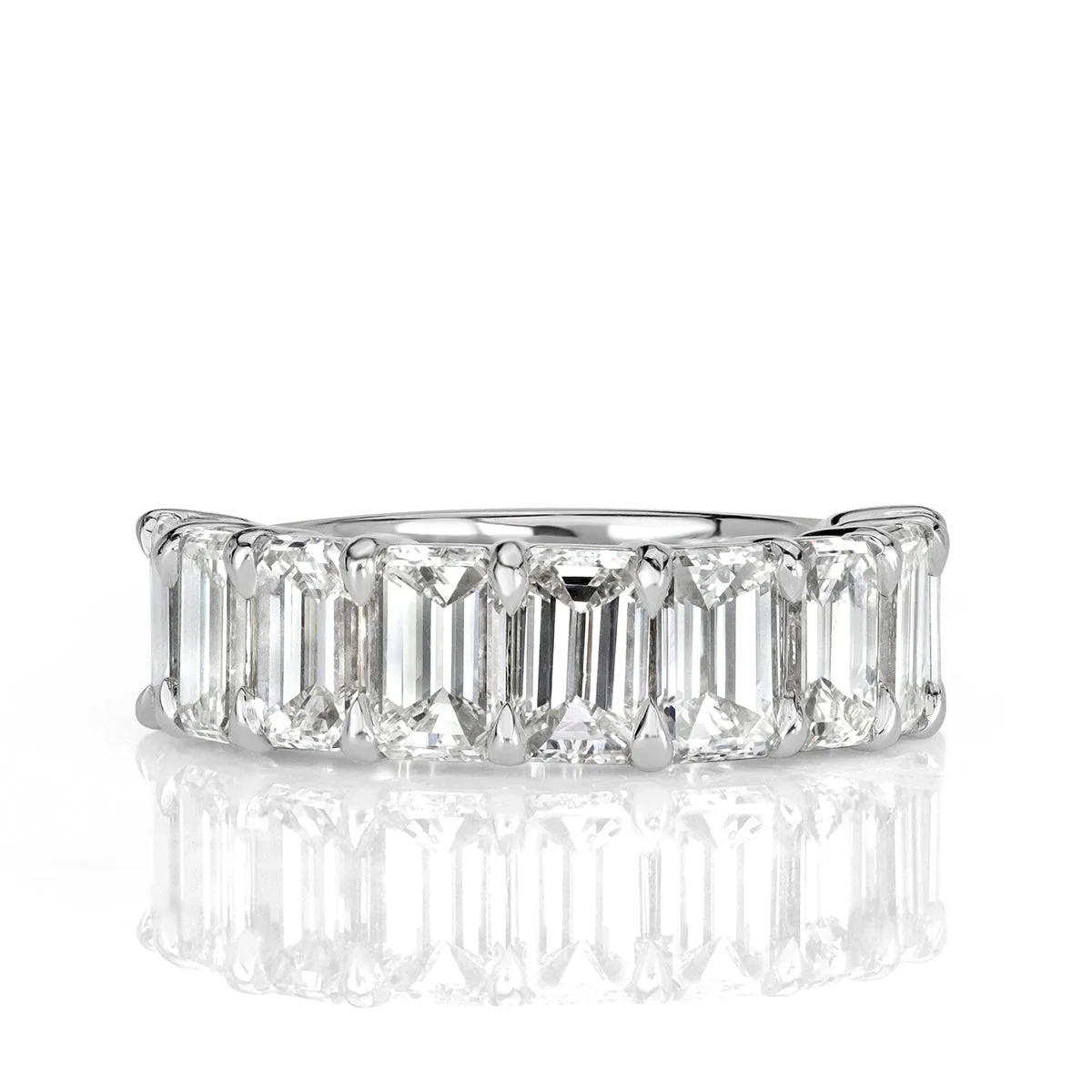
The decision most collectors actually face is not carat weight or shape but a more practical one: full eternity, where diamonds circle the entire band, or half eternity, where they cover roughly the top half only, and that choice carries a sizing consequence that is worth understanding before you buy.
Full versus half eternity: the honest difference
A full eternity ring sets diamonds continuously around the entire circumference of the band. A half eternity ring sets them only across the upper portion, typically the front half to two-thirds, leaving the underside in plain metal. The visual difference when worn is often smaller than people expect, since the upper portion is what shows above the hand in most positions. The practical difference is larger: a full eternity ring, once made, is very difficult to resize, because resizing requires cutting and rejoining the band at a point where diamonds are already set. A half eternity ring, with plain metal at the back, can usually be resized through that unset section with far less disruption to the stone line. If your ring size is likely to change, or you are buying before a final fitting, this is the single most important practical fact in this guide.
Stone matching along a continuous band
As with a tennis bracelet, the diamonds in an eternity ring sit close enough to one another that any inconsistency in color, clarity or cut is immediately visible. Matching becomes more demanding as the band gets larger in diameter, since more stones are needed to complete the circuit at a consistent size. Legacy selects each stone individually for this reason rather than buying in parcels; pieces such as the Round Brilliant Eternity Band in fancy yellow and the Asscher Eternity Band in fancy yellow both demonstrate the level of consistency a matched fancy-color line requires, set in 14K white gold to contrast against the yellow stones.
Shape choice: how it changes the look of the line
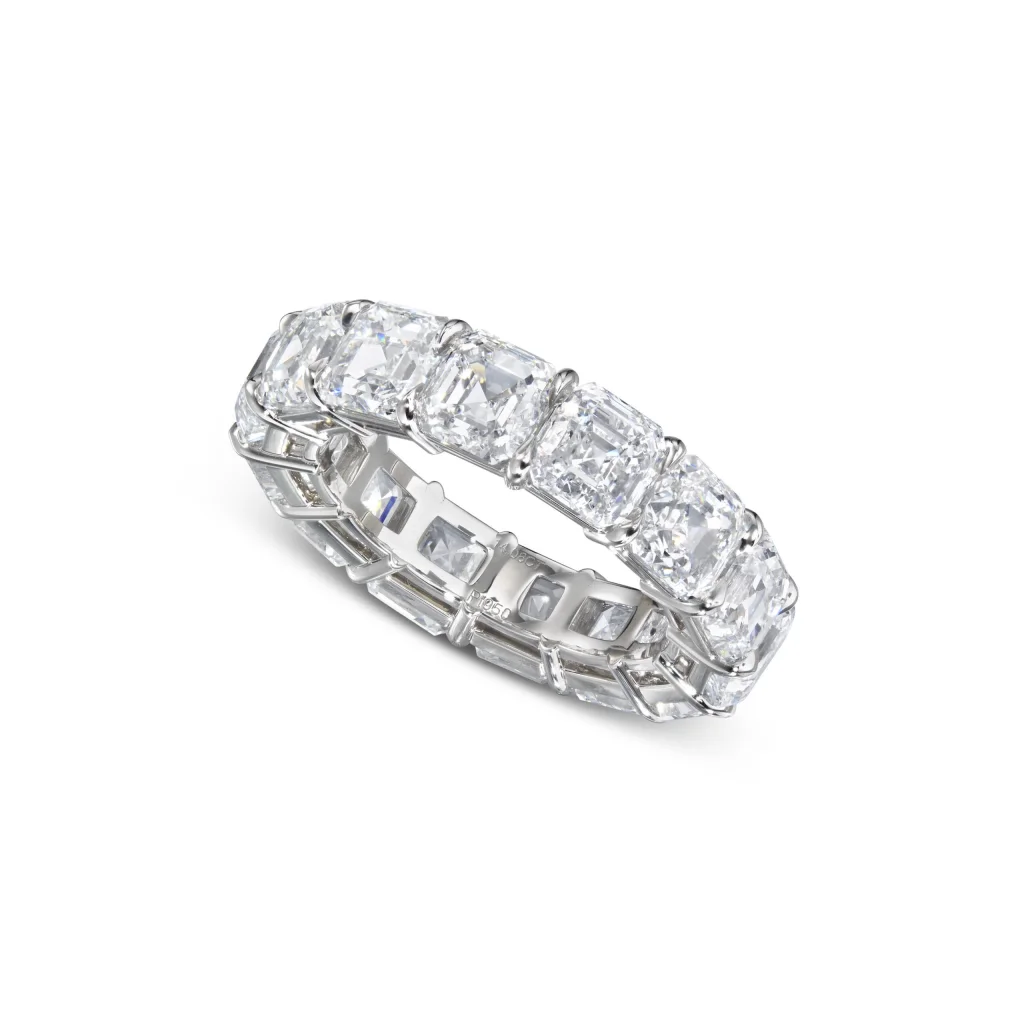
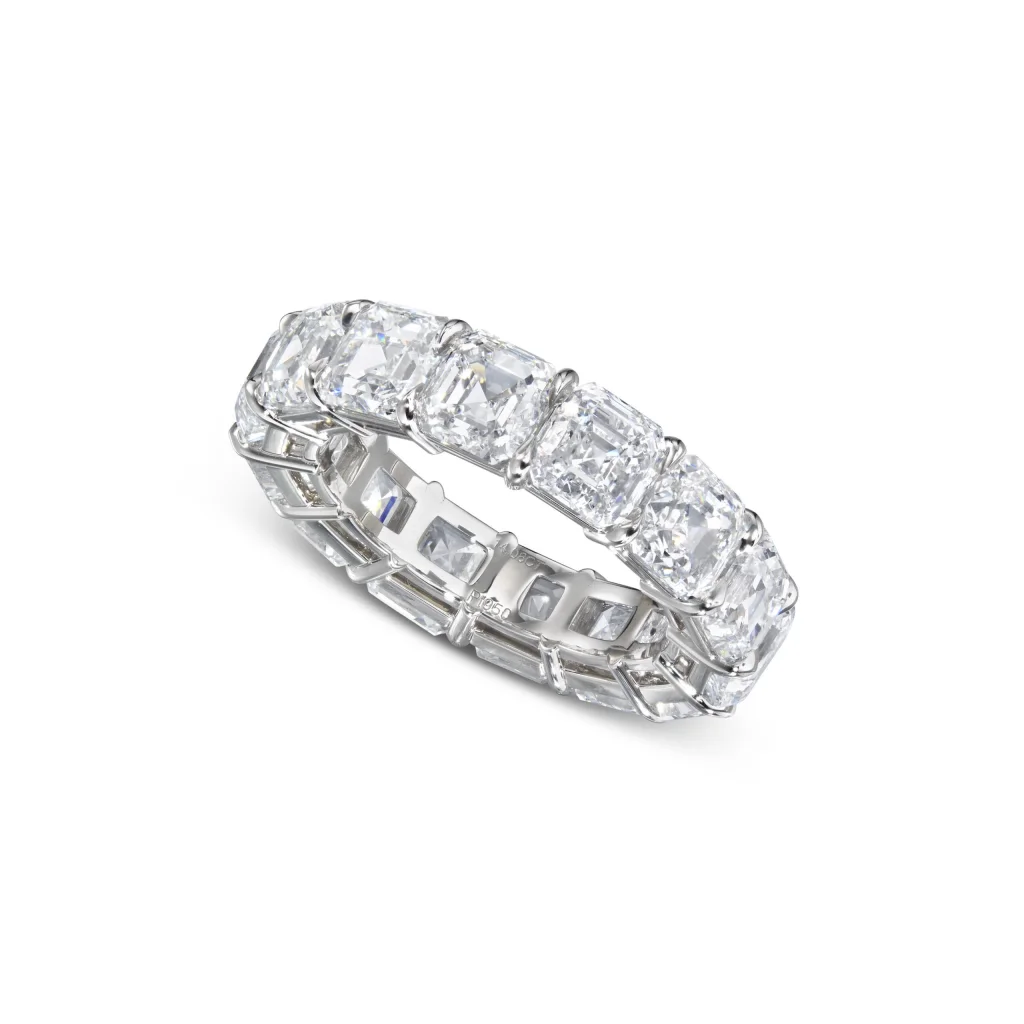
Round brilliant remains the most common shape for eternity bands because its circular outline sits naturally against a curved band with minimal gaps. Asscher and radiant cuts, both step or mixed cuts with more angular outlines, produce a more architectural, tessellated look along the band, but require more precise cutting to sit flush without visible gaps at the joins. Fancy shapes generally carry a premium in an eternity setting over an equivalent round brilliant line, reflecting the additional cutting precision needed to maintain a consistent line around a curve. Baguette and emerald cuts, both step cuts with rectangular outlines, are set less frequently in full eternity bands for exactly this reason, since fitting a rectangular outline evenly around a curved circumference is markedly harder than fitting a round stone.
When an eternity ring is given, and what that means for sizing
Eternity rings are commonly given to mark an anniversary, the birth of a child, or another milestone within an existing relationship, rather than as a first engagement ring. Because the recipient’s ring size is usually already known in these cases, sizing risk is lower than it might first appear, but it is not eliminated, since fingers change size over years through weight change, temperature and age. For a ring intended to be worn for decades, discussing resizing tolerance at the time of purchase, and choosing half eternity where there is any doubt, is a more useful precaution than guessing at a size and hoping. Some collectors also commission a full eternity band deliberately, accepting the sizing trade-off in exchange for a piece that reads identically from every angle when the hand is turned, which matters more for a ring that will be photographed or examined closely than for one worn primarily under everyday circumstances.
Stacking with other rings
Because eternity bands are typically slim, they are frequently worn stacked alongside an engagement ring or other bands rather than alone. A half eternity band sits more comfortably in a stack, since the plain underside reduces bulk against the adjacent ring’s shank. A full eternity band, by contrast, gives a continuous sparkle from every angle but sits proud on both sides, which some collectors prefer specifically for a ring intended to be worn alone.
Metal and setting choices
Platinum and 18K white gold are the most common metals for eternity bands set with colorless diamonds, keeping the metal secondary to the stone line. Where a fancy color such as yellow is used, as in several pieces across Legacy’s current range, white gold is frequently chosen deliberately to contrast against the stone and make the color read more distinctly than it would against a warmer-toned metal. The setting itself, shared-claw, channel or bead-set, changes how much metal is visible between stones and how the band feels against an adjacent ring when stacked; channel settings in particular sit flatter and snag less on fabric, which matters more for a ring worn daily than for one reserved for occasions.
Buying an eternity ring as a first purchase
While eternity rings are most often bought to mark a milestone within an existing relationship, they are also acquired as a standalone purchase, either self-selected or as a first significant diamond ring independent of any occasion. In this case the sizing consideration works in the buyer’s favour: since the ring is being fitted directly to a known, current size rather than guessed at as a gift, there is less reason to default to half eternity purely for resizing flexibility, and the choice between full and half can be made purely on aesthetic and stacking preference instead.
Certification for a multi-stone band
Because an eternity ring contains many stones rather than one, certification is typically documented differently from a solitaire: either as a summary certificate covering the full line’s total carat weight and average grades, or as individual certificates for the more significant stones within it, depending on the piece and the laboratory. Every stone across Legacy’s eternity ring collection is independently certified by GIA, IGI or HRD, with the choice of laboratory arranged on request, and buyers are encouraged to ask specifically how a given piece’s line is documented before purchase, since this affects both insurance valuation and any future resale.
Questions collectors ask
What is the difference between full and half eternity rings?
A full eternity ring sets diamonds all the way around the band; a half eternity ring sets them across roughly the front half only, leaving the back in plain metal. The half version is significantly easier to resize later, since the unset portion allows the band to be cut and rejoined without disturbing the stone line.
Can a full eternity ring be resized?
It is possible but difficult, since resizing typically requires cutting through a section that already carries set stones. Most jewelers will only recommend it within a very small size range, and it carries more risk to the stone line than resizing a half eternity band.
Is an eternity ring only given as an anniversary gift?
It is most commonly associated with anniversaries or the birth of a child, but there is no fixed rule; some collectors choose an eternity band as a standalone statement piece or stacking ring independent of any occasion.
Legacy’s current eternity ring collection and the wider ring collection can be viewed with full certification and pricing on request. Every stone is independently certified by GIA, IGI or HRD, selected individually, and delivered worldwide through Brink’s-insured shipping. For guidance on carat weight and value in the related 1 to 2 carat range often chosen for eternity bands, see our guide to 1 to 2 carat diamond ring value, or arrange a private consultation to discuss full versus half eternity for a specific hand and size.
The Pieces in This GuideThe Vault →
From the Legacy vault — each one-of-a-kind, independently certified.
A private advisor answers on the figures in this guide — and places any piece from the vault within them, certificate first.
More from CollectingAll Guides →
 Diamond Earrings Price Guide: Studs, Drops, What They CostCOLLECTING · AUG 31, 2026
 The Tennis Necklace: Carat Weight and ProportionCOLLECTING · AUG 21, 2026
 The Tennis Bracelet: A Buying GuideCOLLECTING · AUG 21, 2026
 The Riviera Necklace: Graduated Diamonds ExplainedCOLLECTING · AUG 21, 2026Diamond Bracelets Beyond the Tennis Line: Formats and FitCOLLECTING · AUG 21, 2026
 Collecting Diamond Brooches: The Most Undervalued Object in Fine JewelryCOLLECTING · AUG 21, 2026
The Vault, Continued
Every piece one-of-a-kind, every price published. Keep scrolling — the vault does not end here.